

Target’s $5 Billion Expansion: What “Retail-Ready” Actually Means for CPG Brands
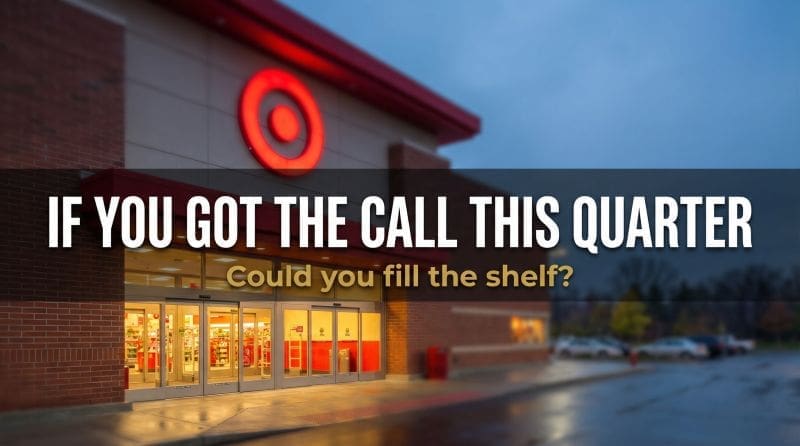
On March 3, Target unveiled its 2026 strategy at the company’s annual financial community meeting. The headline is a $5 billion capital investment plan, with another $1 billion in incremental operating spend on top of it. Food and beverage is getting nearly 50% more newness across the assortment. Vitamins and nutrition are expanding roughly 20% chainwide in April. More than 30 new stores this year. 130 full-store remodels. By 2035, Target expects to add 300 new locations to the chain. For CPG brands, the scale of this rebuild rewrites what retail-ready actually means.
Every CPG founder I know read the announcement and saw the same thing: opportunity.
But Target’s $5 billion plan is not an invitation. It’s a filter.
Target is not adding shelf space for brands that need shelf space. They are adding it for retail-ready brands, the ones that have already proven they can hold velocity without deep trade spend. They are investing into a category they already know works. Food and beverage at Target grew from $15 billion to $25 billion between 2019 and 2025. The buyers running this expansion are not looking for hopefuls. They are looking for evidence.
What retail-ready means at $10M to $20M
Here is the operator-level checklist a buyer applies before they offer shelf space.
1. Clean unit economics
Not projected margins. Actual margins at current volume, with a clear path to maintaining them at 3x the volume.
A buyer will pull apart your margin stack. They will want to see your landed cost, your trade spend assumptions, your slotting absorption, and what your contribution margin looks like after MAP enforcement. If your COGs only work at a scale you have not reached yet, you are not ready. If your unit economics depend on a co-packer rate that requires volume you cannot guarantee, you are exposed.
The brands that hold up in this conversation have done the cost engineering before the meeting. They know which line items improve at scale and which do not. They have already negotiated step-down pricing with their co-packer. They are not asking the buyer to fund their path to profitability.
2. Tight SKU count
Target is increasing the rate of new product introductions across food and beverage. That means more brands on shelf, not more SKUs per brand.
Walk in with your top 3 to 4 performers. Not your full catalog. The buyer is not allocating a four-foot section to your brand. They are allocating two to four facings, and they want those facings to turn. A focused assortment signals operator discipline. A 12-SKU pitch signals that you do not know your own data.
The exercise before the meeting: rank every SKU by velocity, margin, and strategic role. Keep the hero, the workhorse, and one differentiator. Leave the rest at home. If a SKU is not in the top quartile of your existing retail performance, it has no business in a Target pitch.
3. Velocity proof
Recent scan data that shows consistent turns. Not a spike from a promotion. Not a DTC sales curve. Brick-and-mortar velocity that a buyer can project forward.
Buyers think in units per store per week. They benchmark against the category average and against the brands already on shelf. A Circana or SPINS pull showing eight weeks of stable velocity in a comparable banner is worth more than any pitch deck slide. A Whole Foods or Sprouts track record is the warm-up buyers want to see before national mass.
Promotion-fueled velocity is a tell. If your scan curve has a TPR-shaped spike followed by a return to baseline, the buyer reads that as discount dependence. They are not buying that brand. They are buying the brand whose baseline keeps trending up.
4. Distribution credibility
Can you supply 300 stores without a fulfillment crisis? Do you have a 3PL or co-packer relationship that can scale? Have you shipped to a national retailer before, or is this your first?
Target’s OTIF and chargeback regime is unforgiving. A first-time national supplier learns this in the first 90 days, often expensively. The buyer wants to know that your operations provider has shipped Target volume before, that your EDI integration is built and tested, and that your safety stock model accounts for promotional lift.
The brands that survive their first national rollout almost always have one of two things: a 3PL with deep mass-channel experience, or a senior operations hire who has run it at a previous brand. If you have neither, the answer is to build one of them before you accept the PO. Not after.
Retail-ready is the filter
This is not discouraging. It is clarifying.
The brands that get into Target’s expansion wave will be the ones who did not treat the announcement as a dream. They treated it as a checklist. They worked the four points before the buyer call. They walked into the meeting with the data, the SKU rationale, the velocity proof, and the distribution evidence already assembled.
If one of these four would stop you today, that is the work. Not the pitch.
If you want to pressure-test where your brand stands against these four points, what your margin structure can actually support at scale, or what a credible path to retail-ready looks like for your next 90 days, we’re having those conversations every day at Compass Rose.
— Rose Hamilton, Compass Rose Ventures