

What Walmart Changed
(and What It Signals)
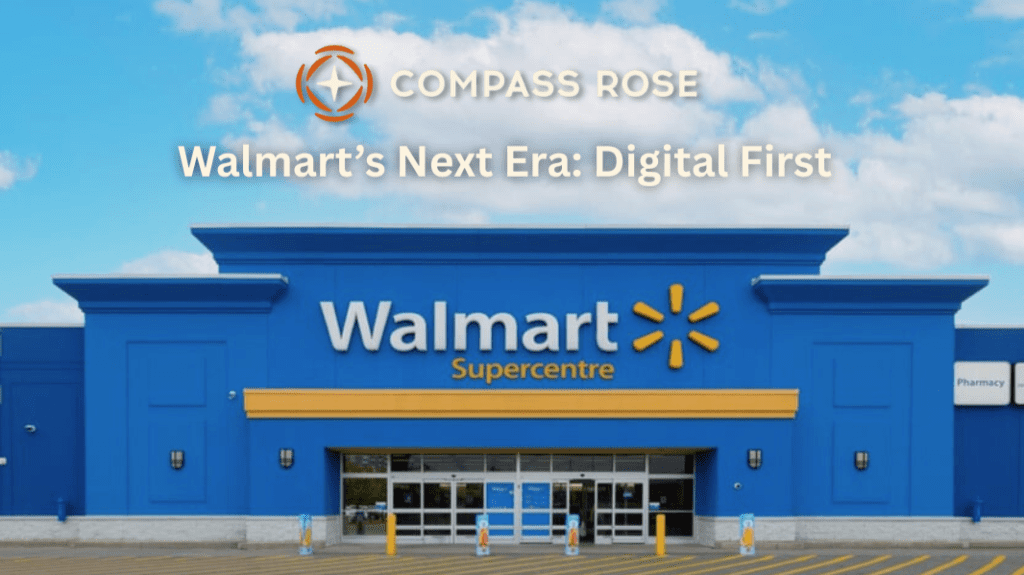
Walmart’s board elected new leaders to its Executive Council, and the changes take effect February 1, 2026.
A few moves stand out:
David Guggina, Walmart U.S. Chief eCommerce Officer, becomes President & CEO of Walmart U.S.
Seth Dallaire moves into an enterprise-wide Chief Growth Officer role, overseeing platforms like Walmart Connect, Walmart+, Walmart Data Ventures, Vizio, and a global Marketplace platform.
Chris Nicholas shifts from Sam’s Club U.S. to President & CEO of Walmart International, succeeding Kath McLay, who is departing the company.
Latriece Watkins becomes President & CEO of Sam’s Club U.S.
And the language matters: Walmart frames these changes as operationalizing its “People Led, Tech Powered” strategy—and explicitly ties the re-org to AI reshaping retail.
This is not a “digital initiative.” This is a platform operating model.
The real headline: eCommerce leadership now runs the core machine
Putting the eCommerce chief in charge of Walmart U.S. is the clearest signal that the default Walmart customer journey is now assumed to be omnichannel with digital at the center.
EMARKETER framed this as Walmart aligning leadership with a digital-first future—a clear indicator of priorities moving into 2026.
In other words: Walmart is aligning who runs the business with how value will be created.
Doug McMillon’s legacy—and the handoff to the next era
Zooming out, this leadership change lands in the context of Walmart’s broader transition at the top. Retail Dive’s look at Doug McMillon’s tenure ties the company’s momentum to a decade of investment in digital, supply chain, and omnichannel capabilities—the foundation of the machine Walmart is now scaling.
Important clarification (and correction): John Furner is not the “incoming CEO of Walmart U.S.” He is set to become President & CEO of Walmart Inc. (the overall company) on February 1, 2026, succeeding Doug McMillon. At the same time, David Guggina will take over Walmart U.S.
The important takeaway: Walmart isn’t treating AI as a layer on top of retail. They’re re-architecting retail around AI + platforms + execution.
My Compass Rose take: 5 implications every brand and retailer should absorb
1) “Platforms” aren’t support functions anymore—they are the growth engine
When the Chief Growth Officer (CGO) owns ads, membership, data ventures, marketplace, and even acquired businesses (Vizio), that’s a statement: growth is increasingly driven by enterprise platforms that compound.
2) The customer experience is now built through shared capabilities
Walmart explicitly describes centralizing platforms to accelerate shared capabilities, freeing operating segments to be closer to customers.
That’s modern retail in one sentence: centralize what scales, localize what differentiates.
3) Agentic commerce is moving from “concept” to operating priority
The industry conversation is rapidly moving toward AI-shaped shopping experiences—and Walmart is staffing and structuring accordingly.
4) Delivery speed and fulfillment are table stakes, not a differentiator
Walmart highlighted delivery reach and speed as a core capability under Guggina’s leadership.
The differentiator becomes what you can do once you have that speed: personalization, inventory intelligence, basket-building, replenishment, and margin expansion.
5) The new advantage is “decision velocity”
When you connect membership + media + marketplace + data + AI, the advantage is not just scale. It’s faster, better decisions—and the ability to execute them across thousands of nodes.
The question I’d ask if I were on the brand side
If Walmart is reorganizing around platforms and AI, then brands should be reorganizing around:
- Retail media + measurement discipline
- Omnichannel assortment strategy
- Content built for AI discovery
- Operational readiness for faster cycles
- First-party data strategy that doesn’t depend on one retailer
Because the old playbook—”win the shelf”—is becoming “win the system.”
Closing thought
Walmart’s announcement reads like a message to the market: Retail transformation isn’t a project. It’s an operating model.
If you’re a retailer, brand, or investor, the opportunity is the same: build platforms, instrument everything, and use AI to compress the distance between insight and execution.
If you want to pressure-test what this shift means for your category, your margin structure, or your growth roadmap, we’re having those conversations every day at Compass Rose.
— Rose Hamilton
Compass Rose Ventures